
Images
        |
Sources
|
details learning activities topics |
Relying on specialized literature, SS documents, and prisoner sketches, students from Lower Saxony reconstructed the arrival procedures at five concentration camps. To better understand what being confined was like, the students contacted survivors of the camps. They then exhibited the results of their research. During a stay at the Buchenwald Youth Center, the students also created artwork to memorialize individual victims.
Working Process
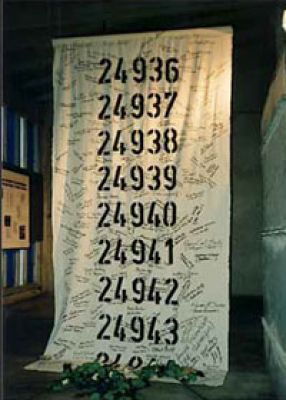
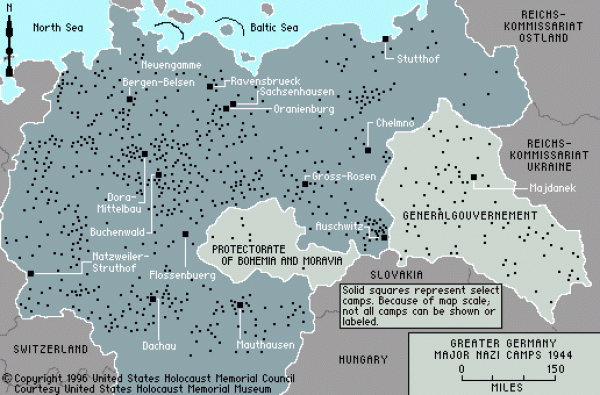
During their summer break in 1995, students from the Cooperative Comprehensive School (KGS) in Stuhr, Lower Saxony, traveled to Dachau, Buchenwald, Ravensbrück, Neuengamme, and Hanover-Ahlem concentration camp memorials in order to gain a better understanding of the process of degradation suffered by prisoners when they were turned into numbers on arrival in concentration camps. The staff of the memorial archives helped the students find an unexpectedly large number of prisoner art works and reports that documented the importance of arrival procedures.
During the following school year, the students evaluated their research as the class project for their Protestant religion class. The goal was to organize the materials into.a traveling exhibition entitled "From Name to Number." Participation was voluntary, but it was assumed that fifteen students would be actively involved.
Exhibition
The idea for the exhibition had originated during a previous visit to the Buchenwald Memorial. The exhibition was eventually planned with the help of Bernd Gempe, a member of the memorial's educational staff. The archives of the Auschwitz State Museum, the Institute of Contemporary History in Munich, the Bergen-Belsen and Sachsenhausen memorials, and the German Federal Archives in Koblenz and Potsdam each contributed supplementary material. Thomas Rahe, director of the Bergen-Belsen Memorial, advised the group on the problems of using prisoner art and survivor reports.
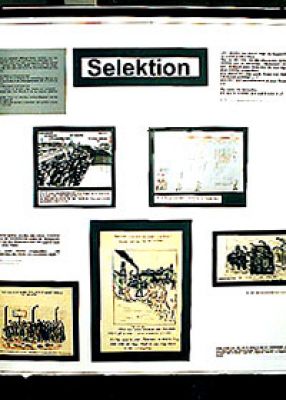
The exhibition was put together with the following steps. First, students prepared text panels about concentration camp arrival procedures using specialized academic literature. Then they systematically organized SS documents and prisoner drawings based on the sequence of arrival procedures, and they chose concise passages from literature to describe the experiences and emotions of the prisoners. Next, working in small groups, the students reconstructed the arrival procedures for prisoners in five concentration camps.
The students also chose drawings that they had made for the exhibition during their visit to the youth center at Buchenwald. And finally, the students contacted survivors for more details about the arrival process.
The exhibition, which opened at the KGS in Brinkum in June 1996, was divided into three sections: the dehumanizing procedures upon arrival; the unique aspects of arrival procedures at each of the five concentration camps; and survivor eyewitness accounts. Each described prisoners' suffering as they were turned into numbers in the concentration camps.
First Section
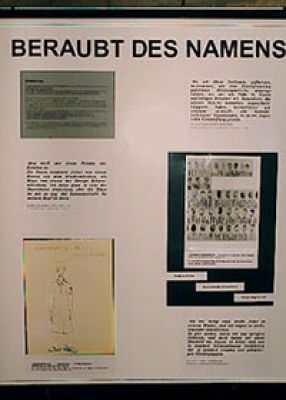
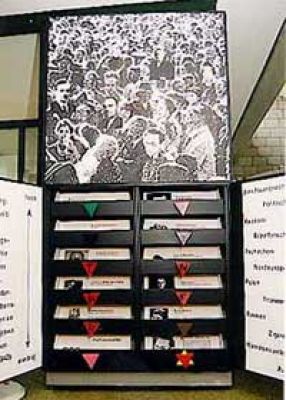
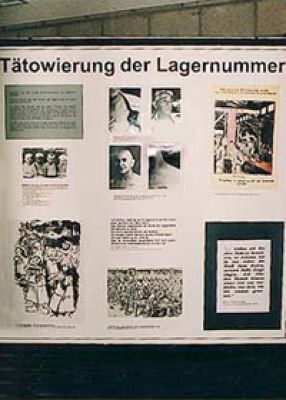
SS documentation in the first section of the exhibition demonstrated the process of degradation. Humiliating the prisoners by turning them into numbers made it easier for perpetrators to systematically plan the factory-like processes for murder. Upon arrival, the SS not only robbed individuals of their freedom, but also their clothing, personal belongings, hair, dignity and names. SS photos and documents presented arrival at a concentration camp as a sober, bureaucratic, and functional process. A Wehrmachtsfrachtbrief [military freight letter] describing five train cars full of prisoners contains nothing about the pain and death of the deportees. The crime is clear only when perpetrator documents are juxtaposed directly with evidence from the victims, making the victims' perspectives.and suffering central. In the exhibition, prisoner literature and art supplemented this material, allowing the individual to become visible again. A number of prisoners clandestinely drew or wrote in order to counteract the loss of dignity and self-respect. The prisoners drew quick realistic pencil sketches of the degrading arrival process, showing the depersonalization of broken victims. If caught, prisoners faced possible torture and death.
Most of the approximately forty sketches in the exhibition were created under extreme conditions in the camps. Due to shortages of paper and other supplies, prisoner artists used any suitable material: scraps of paper, the backs of SS forms, coal, or pencil stubs. The original drawings were often small so that they were easier to hide. Most of these drawings were enlarged for the exhibition. Color drawings, such as the watercolors by the artists imprisoned in Buchenwald, are rare. Only those prisoners ranked high in the prisoner hierarchy, such as political prisoners protected by their comrades, were able to obtain paper and paint. Artists such as Thomas Geve, Alfred Kantor, Wladyslaw Siwek and Mieczyslaw Koscielniak produced most of the colored and detailed works of art after liberation, when they were no longer in physical danger.
Very few well-known photographs were used in the exhibition, since they have become icons that would cause the visitor, especially students, to "write off" events as already known. Instead, the juxtaposition of SS photos and documents to prisoner drawings and quotations allowed the viewers space for their own perspectives. Personal testimonies made it possible for the visitor to become emotionally involved, while simultaneously demonstrating the unbridgeable gap between the viewer and historical reality. Each visitor was left to decide the meaning of this past for him or herself.
Second Section
The second section of the exhibition dealt with arrival procedures and experiences at five concentration camps. The exhibition used historical photos matched to a map of the camp to show the arrival of prisoners at Dachau, the model for other concentration camps, where arrival procedures were "tested." Historical photos and a camp map showed the arrival of prisoners. The arrival process eventually changed in the late 1930s with structural and functional alterations in the concentration camp system.
These changes, especially the role of political prisoners during the arrival of transports, were presented in detail on a panel about Buchenwald. The discussion of Ravensbrück focuses, through quotations and drawings from the.camp, on hair shaving and gynecological exams performed on women prisoners. Initially, the exhibitions developers decided not to explore gender specific experiences during arrival in order to avoid hasty or simplistic generalizations and comparisons of the suffering of women and men.
The Bergen-Belsen internment camp was unique because some Jews destined for ransom exchanges were allowed to keep their belongings, clothes and hair.
In Hamburg, two students visiting the Neuengamme memorial found that a prison is now located on the grounds of the former concentration camp!
Third section
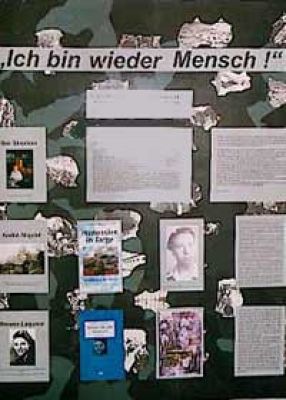
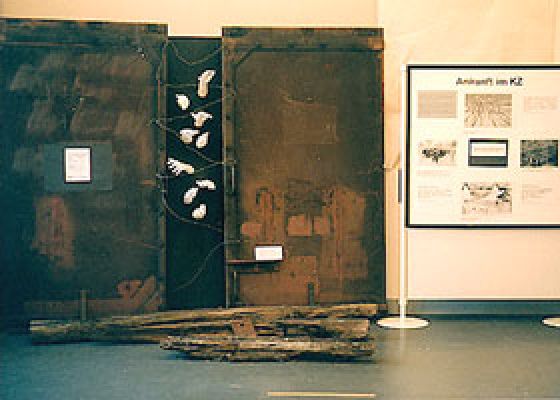
The third section of the exhibition opened with the sentence "I am human again!" taken from a letter written by Ilse Stephan after liberation from Bergen-Belsen. In this segment, survivors, men and women who had been depersonalized by numbers, are introduced through photos, personal histories, books and letters that offer testimony about Nazi crimes, and all those who supported and cheered the Nazis. This testimony, which included the statements of only those survivors who had not published books or memoirs, also documented the humanity of the victims. In the exhibition, the students used charred photographs pasted on pieces of gray-black cardboard along with survivor narratives to suggest that survivors still live with this trauma more than fifty years after liberation.
Art Works
In the space between the twenty-two exhibition panels, student art works were displayed by theme. These works were made during the students' visit to the Buchenwald memorial. They commemorated the victims and their pain, and also linked historical events with the present and helped to create visual "stumbling blocks" that encouraged the visitor to take a stand and to identify emotionally with the past. The exhibition also helped visitors visualize and understand complex historical events.
Slides
Slides showed daily camp life from receipt of a prisoner number until death. At the close of the exhibition, the words "Is this a human being?" were projected on the back of a plaster of Paris body.
We hope the exhibition led people to remember Nazi crimes and to commemorate the victims and survivors.
