
Download (PDF, Powerpoint, Documents, ...)

Images
   |
Sources
|
details learning activities topics |
After meeting the American jurist Robert Kempner, students mounted an exhibition on the life and work of the former co-counsel at the Nuremberg Trials. The exhibition, which includes readings from selected unpublished trial interrogations, has been on view in the school and throughout Germany since 1989. An important element in the exhibition is a video interview with Mr. Kempner, which the students produced.
History of the Exhibition: "Eternal Vigilance is the Price of Freedom"
Students and teachers at the Adolf-Reichwein Gymnasium in Heusenstamm first had contact with Robert Kempner as a result of an exhibit the school dedicated, on the occasion of the school's twentieth anniversary in 1986, to its namesake, Adolf Reichwein, a resistance fighter murdered by the Nazis in 1944. After seeing press reports about the exhibit (for example, Horst Brandl's speech about Adolf Reichwein's current significance, "Muss das Wort 'anständig' nicht aus der Wortliste gestrichen werden?" ["Must not the word 'decent' be removed from the vocabulary?"] published in the Frankfurter Rundschau on January 13, 1987), Dr. Robert Kempner contacted the school to express his respect for Reichwein and to discuss the Nazi past.
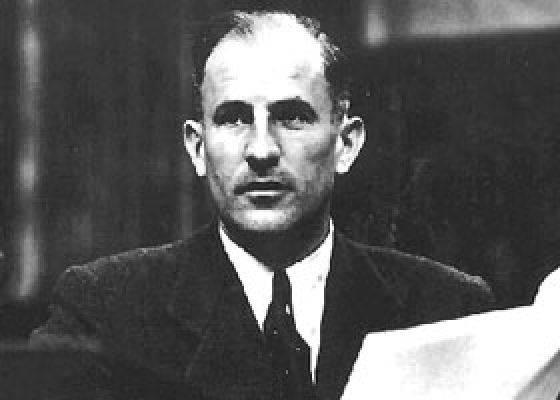
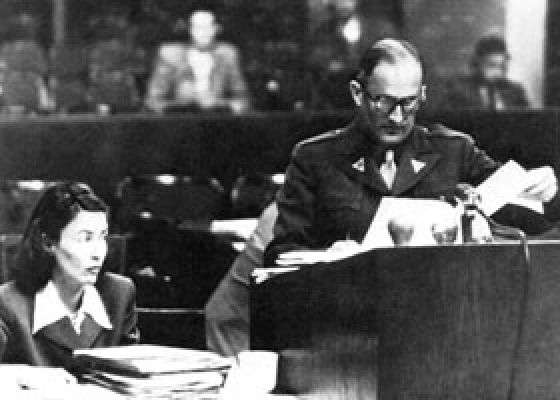
As a young attorney, Kempner had experienced the agony of the Weimar Republic. His legal shrewdness, combined with incorruptible democratic principles, allowed him to recognize the symptoms of the collapse of Germany's first democracy at an early stage. Even after his emigration from Germany and after World War II, Kempner consistently continued his fight for democracy and justice. As one of the American prosecutors in the Nuremberg trials, he was involved in the development of international law and the international judicial system [see Visuals].
In 1989, Kempner's ninetieth birthday prompted a group of teachers and students at the Adolf-Reichwein Gymnasium to stage an exhibit documenting his life and contributions to German democratic justice. The exhibit -- the first on Kempner's life - opened at the Adolf Reichwein Gymnasium in November 1989, and subsequently traveled to several other cities.
By the end of 1992, xenophobic violence in unified Germany had increased dramatically, reinforcing the currency of the phrase "eternal vigilance is the price of freedom." In response to the violence, students and teachers decided to remount the exhibit at the Adolf-Reichwein Gymnasium. Robert Kempner wrote the following on the occasion of the exhibit reopening:
"I am deeply moved that this exhibit will again be shown at the Adolf Reichwein Gymnasium in Heusenstamm. Political developments during the last three years have shown that a one-time presentation of this exhibit does not suffice. On the contrary, exhibits like this one become ever more necessary and must always be repeatedly presented to the younger generation. Only through exhibits such as this, can one ensure that the crimes of the past are not forgotten."
At the time of the opening, members of the Robert Kempner Association, which had formed as a result of the school's relationship with Kempner, began considering how to continue work on the exhibit. As a result of the association's efforts, an improved professional design, completed thanks to generous financial support, now starts with the legal system of the Weimar Republic. It then covers the ways in which the Nazis corrupted and misused this system, the Nuremberg trials, and the reconstruction of the postwar German legal system. It also includes a critical treatment of how the legal system of the Federal Republic of Germany has dealt with the heritage and history of the judiciary in the Nazi era.
The exhibit should carry on the irrevocable ideas of Robert Kempner who contended that after the Nuremberg trials, no government should feel secure in misusing its own state to commit crimes against humanity -- and therefore against the human race. He also believed that an effective jurisdiction requires the support of everyone in order to protect human rights and to have the ability to condemn such crimes.
On March 6, 1995, the revised exhibit was presented in the Paulskirche in Frankfurt. Since that time, a traveling version has been seen at schools and other venues throughout Germany, and exhibit sponsors now have the option of inviting visiting student groups to perform readings of Kempner's trial interrogations. One student group chose passages from Kempner's unpublished interrogations of Johanna Wolf, Hitler's private secretary, Erich Neumann, State Secretary of Trade and Commerce, and Günther d'Alquen, editor of the SS journal "Das schwarze Korps" ["The Black Corps"]. The interrogation of Erich Neumann illustrates the career of a classic bureaucratic "desk-top" perpetrator [see Documents].
